Skipjack Nautical Wares Banner

Showing posts with label antique. Show all posts

Thursday, October 15, 2026

A Whaler's Sea Chest From the Collection of Henry Alexander Murray


 A sailor's sea chest was one of his most important possessions — on a long voyage it held everything he owned, and served as his table, his chair, his bank, and his bureau. Most were plain and utilitarian. The chest now in our webstore is something else entirely: a mid-19th-century decorated six-board sea chest, American, probably New England, that is exceptional in both construction and decoration.

Top of the sea chest lid with painted whaling scene.

The chest is built of white pine with nailed joints and a canted front and back. The single-board top carries tooled molded edges and applied end cleats — structural details added to keep the lid true against warping. The top hangs on snipe hinges, an early forged-iron form made from cotter-pin-like pieces driven through the top and the chest back, their hooked ends interlacing to form the hinge itself.

White pine was used to build this sea chest. Closeup view of one
of the snipe hinges, fastening the top to the chest.

The lid's exterior carries a colorful panoramic painting of a dramatic whaling chase scene, enclosed within a painted rope border that follows the lid's rectangular outline. Lift the lid and the underside is left in natural pine, bearing a painted silhouette of a black sperm whale backed by a crossed whaler's harpoon and oar. 

View of the interior lid with black silhouette painting of a whale
with crossed harpoons.

The chest's exterior is painted olive green. Inside, a ditty box (till) is fastened in the upper right with a single drawer and an open cavity below. 

The interior till (ditty box) with lower drawer.

And in a detail collectors will appreciate: the original leather-wrapped beckets survive, with their painted-wood side cleats, and the original lock remains in place (the key is missing).

Original leather-wrapped rope becket sea chest handle with 
green-painted side cleat.

Dimensions: 39 3/4 inches wide, 18 1/2 inches deep, 17 1/4 inches high.

Painted chests come to market regularly; chests with a period whaling chase scene on the lid, original beckets intact, and an undisturbed ditty box do not. This is a rarity in the survival sense — a decorated whaler's chest where everything that should have survived, did.

PROVENANCE: The chest came from the personal collection of Henry Alexander Murray (1893–1988) — Harvard psychologist, leading authority on Herman Melville, twice president of the Melville Society, whose collection of Melville books, manuscripts, and artifacts was donated to the Berkshire Athenaeum in Pittsfield, Massachusetts. A man who spent a career inside Melville's world owned this chest, and that ownership is what moves it into a different tier. We price it at $6,250 — above comparable decorated chests — because the Murray provenance, combined with the piece's physical rarity, puts it in museum-quality territory. There is one, and only ever one, of these.

See the full listing and photographs on our webstore:https://www.skipjackmarinegallery.com/a-mid-19th-century-whalers-personal-sea-chest-with-painted-whaling-chase-scene.html — $6,250, one in stock.

Visit us at 1172 State Route 32, Round Pond, ME 04564. Open year-round, Thu–Sat 11–4, Sun 1–4, Mon 11–4, and by appointment. (207) 219-0897


Monday, September 4, 2017

"10 Best" Nautical Table Lamps

Skipjack's "10 best" nautical tables lamps created in our lamp studio. Which of these lamps would you find suitable for your home or office?

Photo images are the sole property of Skipjack Nautical Wares & Marine Art Gallery and cannot be reproduced without the written permission from Skipjack Nautical Wares & Marine Art Gallery!


1. Very salty authentic antique anchor lantern re-purposed into a nautical table lamp. Features a thick, clear glass 360 degree Fresnel lens and an open bottom to access the interior light and the lamp lighting choices toggles between the interior light and the lamp light via the upper light switch. You can use either the upper room light, the interior lantern light or both as desired. Here's the link to Skipjack's nautical table lamps.

Authentic antique ship's anchor lantern re-purposed in to a
 nautical table lamp. Skipjack Nautical Wares & Marine Art Gallery.

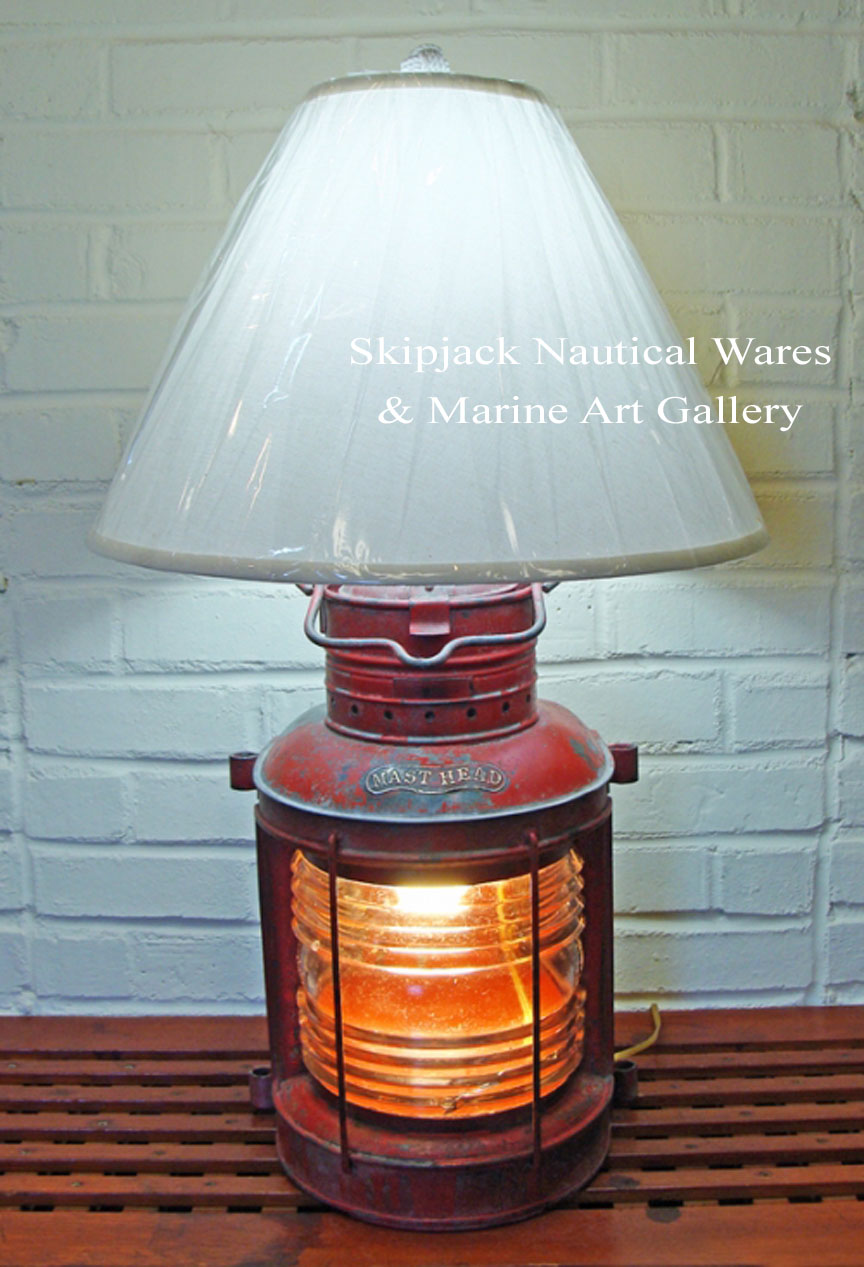
2.  We've re-purposed this retired mid-20th century ship's navigational light into a handsome and functional nautical table lamp. Made of galvanized metal, the surface retains an old red painted surface and bares the MASTHEAD brass ribbon tag on the front shoulder of the fixture. The glass Fresnel lens survives with a few cracks and rim chips, but is all intact and functional.
We've added all new lamp wires and fixtures and the new lamp lighting choices toggle between the interior light and the lamp light via the upper light switch. You can use either the upper room light, the interior lantern light or both as desired. You gain access to the lamp interior through the hinged back door that locks in place with a wire slide latch. Here's the link to authentic mid-20th century ship's navigational MASTHEAD light. 
 Re-purposed authentic mid-20th century ship's navigational MASTHEAD
light into a handsome and functional nautical table lamp.
Skipjack Nautical Wares & Marine Art Gallery.

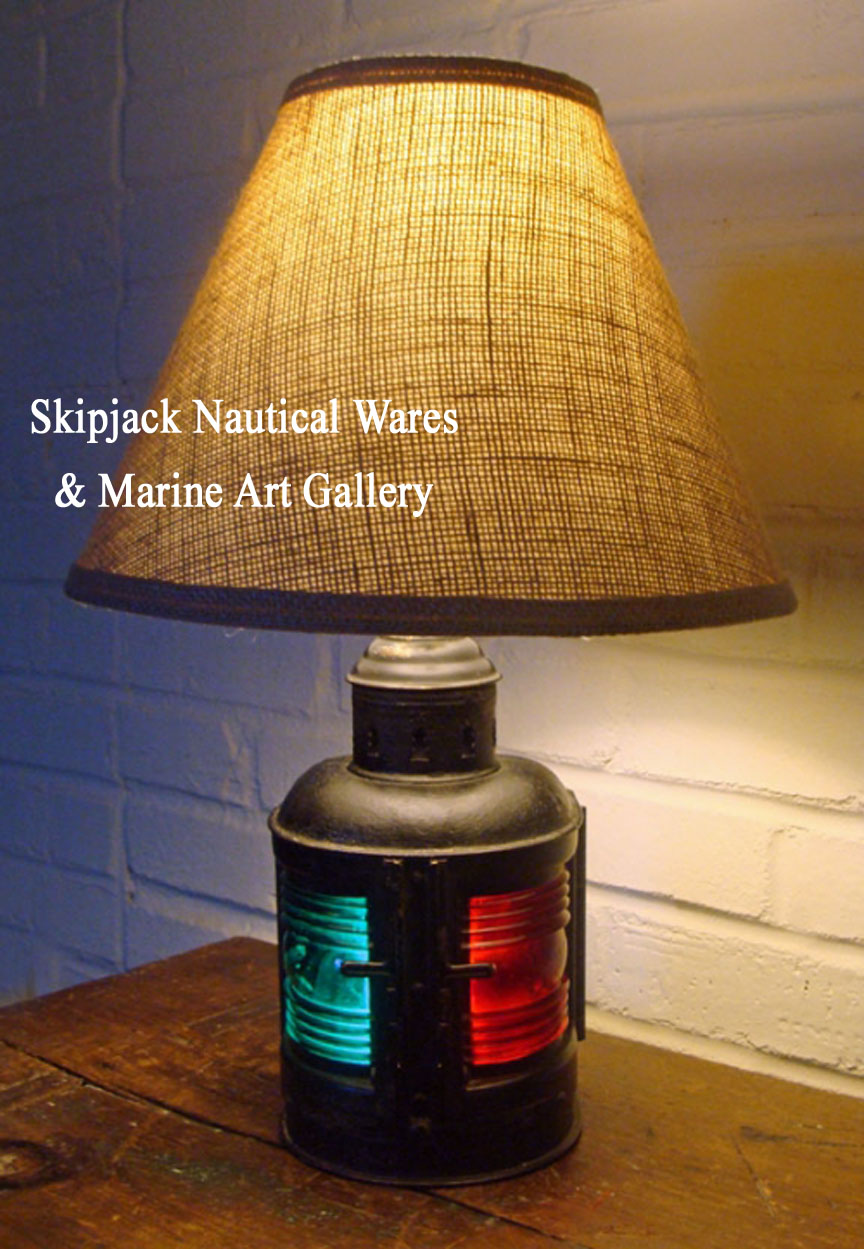
3. Early to mid 20th century Perko combination boat running light that we have re-purposed into a nautical table lamp. The lantern is hinged on the sides and both the port and starboard doors open in front of the light. The oval brass Perko manufacturers label is attached to the back and states "PERKO DE-LITE, PERKINS M.L. CO. BRKLYN. NY. USA". Retains an old black painted surface and brass chimney cap and survives with expected surface wear from years of seagoing use. Fresnel lens are free of chips or cracks.  Here's the link to old Perko port/starboard nautical table lamp.
Antique Perko port/starboard boat navigational light re-purposed into a
nautical table lamp with red and blue Fresnel lens.
Skipjack Nautical Wares & Marine Art Gallery.

4.  Another favorite authentic items that we regularly re-purpose are vintage wood ships block and tackle into table lamp. This example features an authentic 4-inch double wheeled maple block with hemp rope passing through the purchase and into the round 7-inch wood base. Here's the link to vintage wood ships block and tackle into table lamp.
Handsome nautical table lamp created using an authentic ship's wood block with tackle. Skipjack Nautical Wares & Marine Art Gallery

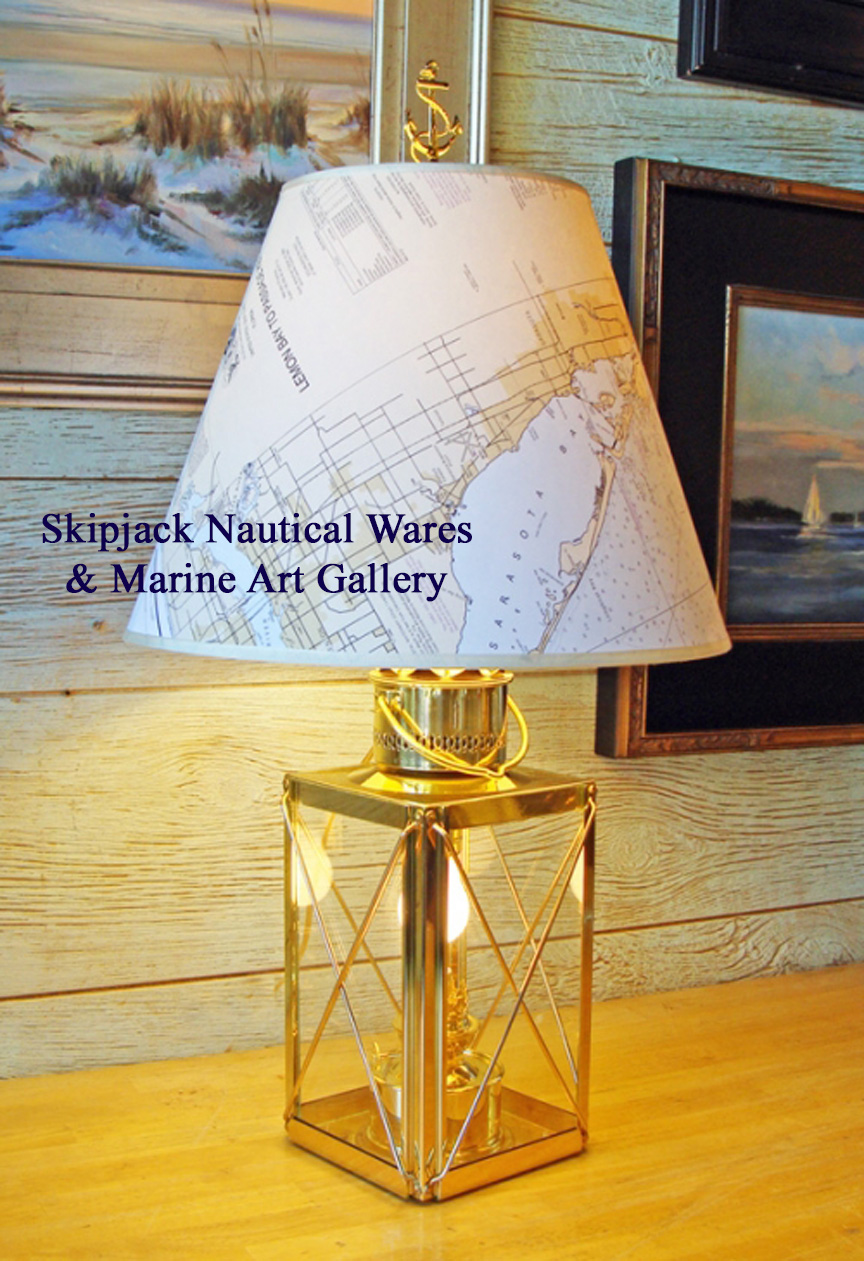
5.  Not all of our nautical lamp conversions are made using vintage and antique light fixtures. For example, This beautiful brass Cargo Lantern table lamp is the perfect light to use in your nautical room and coastal home! The lamp is constructed of solid brass with a polished and lacquered finish to ensure a long lasting shine. Features removable glass panes for easy cleaning and replacement if one accidentally gets broken! The lamp lighting choices toggle between the interior light and the lamp light via the upper light switch. You can use either the upper room light, the interior lantern light or both as desired. The interior bulb is reached through the bottom of the fixture by twisting and removing the interior burner. This high-quality ship's cargo lantern is made to commercial ship standards. Here's the link to Skipjack's brass Cargo Lantern table lamp.
 This beautiful brass Cargo Lantern table lamp is the perfect light
to use in your nautical room and coastal home!
Skipjack Nautical wares & Marine Art Gallery.

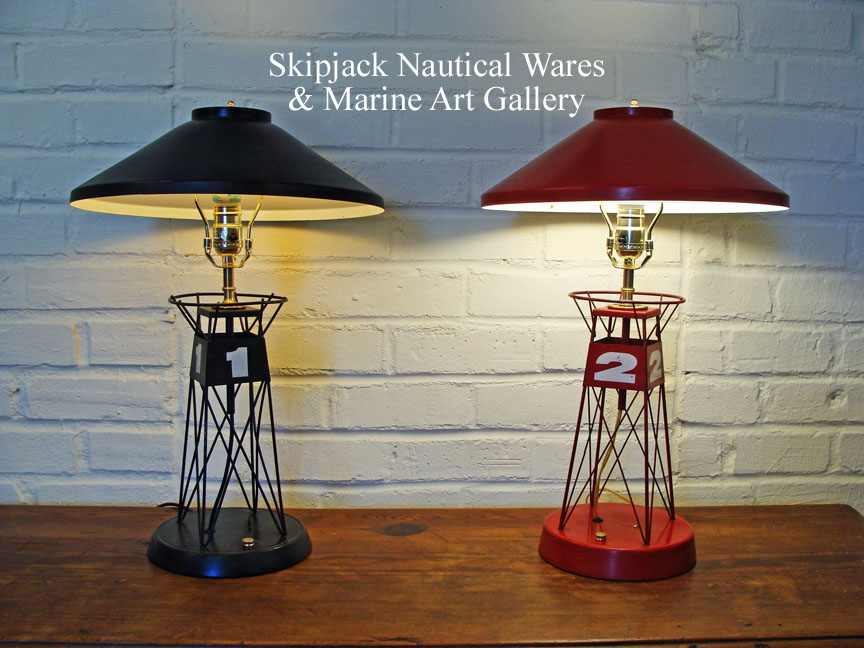
6.  This is a pair of vintage made buoy table lamps that we restored replacing all of the old fixtures and wires as well as touching up the old painted surfaces. I like this pair of lamps next to a sofa, on a sideboard and as a pair of lights next to your bed. These lamps are no longer on our web store, but we do find them occasionally and offer them restored for sale, Here's the link to our nautical table lamps.
Vintage marine buoy nautical table lamps that restored.
Skipjack Nautical Wares & Marine Art Gallery

7.  This 1960’s vintage anchor lantern has been re-purposed into a nautical table lamp, constructed of solid brass and retains a polished and lacquered finish. The glass that protects the burner and font is a Fresnel lens similar to the type used in lighthouses worldwide. This lens amplifies the light from the bulb so that the light appears much brighter than its actual source. Brass wire guards fastened on with copper rivets protect the lens from potential breakage.
The lamp lighting choices toggles between the interior light and the lamp light via the upper light switch. You can use either the upper room light, the interior lantern light or both as desired. A dimmer can also be added to adjust the light intensity for soft ambient light. The interior bulb is reached through the hinged lid of the fixture. Here's the link to vintage brass anchor nautical table lamp.
Skipjack's hand-carved white whale table lamp.
Skipjack Nautical Wares & Marine Art Gallery.

8.  One of my all time favorite nautical lamps that we've produced was this exceptional pair made from early blocks with tackle that we sold a few years back. These retained their original green-painted surface and gorgeous aged patina. Very large and extremely heavy- unsurpassed quality for those seeking the very best! Contact us to discuss your nautical lamp desires. Our inventory is constantly changing with new items arriving daily. 
An exceptional pair of re-purposed ship's blocks into table lamps.
Skipjack Nautical Wares & Marine Art Gallery. 

9.   Here's another new and authentic marine navigational light that we re-purpose into nautical table lamps are these beautiful authentic port and starboard brass ship's lanterns converted to table lamps. Each lamp has two sockets, one interior and one above under the lampshade. These lamps are made from brand new, never-used, ship's lanterns by the famous Den Haan Roterdam, The Netherlands. New, UL approved sockets and wiring. One turn knob above the lamp allows either just interior light, just lamp light, both lights, or no lights.  Here's the link to authentic port and starboard brass ship's lanterns converted to table lamps.
New brass port and starboard navigational lights with red and green
Fresnel lens re-purposed into nautical table lamps.
Skipjack Nautical Wares & Marine Art Gallery

10.  We'll finish up this year's "top ten" with one of my personal favorites-  a classic authentic WWII era US Navy quarterdeck bell re-purposed in to a nautical table lamp. We re-purposed this bell because of an old repaired crack (barely noticeable) but no longer produces a bell ring. See closeup pictures below.
This cast iron bell was made by the "Harvard Lock Company NY" as embossed on the top of the bell and U.S.N embossed on the bell's lower rim. The bell measures a base diameter of 9 1/2 inches and a height of 9 inches including mounting stem and 19-1/2 inches to the top of the lamp shade (as shown). This Navy bell table lamp will make a nice addition to any nautical inspired interior and home. The bell weighs approximately 17 pounds.
Nautical table lamp that we created using an authentic WWII era
U.S, Navy cast iron quartermaster bell.
Skipjack Nautical Wares & Marine Art Gallery.

These nautical table lamps represent the quality that we produce and offer for sale at Skipjack Nautical Wares & Marine Art Gallery. You can peruse our current collection of table lamps and other nautical lamps, lighting, lamp shades and finials our our web store at Skipjack's lamps and lighting. Also, you should take the time to visit all that we have to offer you- here's the link to Skipjack's home page .   
Photo images are the sole property of Skipjack Nautical Wares & Marine Art Gallery and cannot be reproduced without the written permission from Skipjack Nautical Wares & Marine Art Gallery!
Skipjack Nautical Wares 
& Marine Art Gallery
1172 State Route 32, Round Pond, ME. 04564
207-219-0897 ~ skipjacknauticalwares@gmail.com
www.SkipjackNauticalWares.com


Tuesday, August 22, 2017

Re-purposing Authentic Marine Lighting into Nautical Table Lamps

Re-purposing Authentic Marine Lighting into Nautical Table Lamps

We offer one-of-a-kind nautical table lamps created using authentic vintage and antique marine ships lights, lamps and lanterns. We also produce nautical inspired table lamps re-purposed from other authentic maritime items such as wood blocks and other shipboard items, handcrafted driftwood sculpture and fancy knot work lamps and as well as colorful coastal creations including painted vintage lobster buoys and hand-blown netted glass jugs and other coastal beach home favorites.  

Check back regularly to view our latest nautical table lamp creations as they are added to the Skipjack Nautical Wares web store or come by and visit us at our showroom in Olde Towne Portsmouth, Virginia! Visit our great selection of nautical table lamps and also our gallery full of everything nautical at Skipjack Nautical Wares & Marine Art Gallery.

Thursday, August 11, 2016

Evaluating Antique Binoculars

 It is a daily occurrence that we are asked to tell them what their item is worth, and for the appraiser, one that is simply impossible to correctly evaluate for each and every situation.

 There are a lot of variables that go into appraising and evaluating an item. As a
general overview, these considerations are the product maker, age, condition including any restoration to fix or enhance an item, rarity, proven provenance (not here say) and general interest in a product at any given time, and of course that will most likely change with time.  

Appraisals are written for a number of purposes. Insurance, to correctly appraise for replacement considerations, fair market value for resale, tax donations, inheritance and equitable distribution of an estate to heirs to name a few. These values range in number, for instance an insurance appraisal is its highest price evaluation for replacing an item similar in quality, age, manufacturer or maker, provenance, condition, rarity etc. from a source that offers these items for sale. 

But, these are not the same value as one would expect to typically receive since most people selling items, even on web sites like ebay, are not specialized retail dealers. Also, if one is offering an item to a dealer, do not expect them to buy it at retail value nor anywhere close to it, since they are in the business of buying for resale and need to make a reasonable return on their time, overhead and financial investment. 

Also, appraisers have to physically see an item to appraise it and cannot give you that information over the phone! Appraisal services are NOT free and are typically charged by the item or on an hourly basis.

I’ll have to add here, the dollar value of an old item should be to a collector its least interesting aspect. However, the value does play an important part of the appraisal evaluation, as shown above, but I do recommend that you consider first and foremost the desire to own an item and what that item is worth to you.

BINOCULARS

There are a number of styles of binoculars, and the description used to refer to them can vary.  Typically, 'field glasses' or ‘binocular telescopes’ are a pair of identical or mirror-symmetrical telescopes mounted side-by-side and aligned to point accurately in the same direction, allowing the viewer to use both eyes (binocular vision) when viewing distant objects. Most are sized to be held using both hands, although sizes vary widely from opera glasses to large pedestal mounted military models.

Early 20th century field glasses made by chevalier, Paris.

Unlike a (monocular) telescope, binoculars give users a three-dimensional image: for nearer objects the two views, presented to each of the viewer's eyes from slightly different viewpoints, produce a merged view with an impression of depth.

These are low power, have a very small field of view, and do not work nearly as well as prism binoculars.    In a smaller size, they are opera glasses, and their value increases if they are covered with mother of pearl, abalone shell, ivory or other exotic materials.  Field glasses are typically the most affordable unless they are a very unusual form or manufactured by the top makers, such as the German companies such as Zeiss or Leitz.

German made WWII era Carl Zeiss binoculars are one of the top makers of binoculars.


Prism binoculars. Optical prisms added to the design are another way to turn the image right way up, usually in a Porro prism or roof-prisms design.

Porro Prism Binoculars

Porro prism binoculars are named after Italian optician Ignazio Porro who patented this image erecting system in 1854, which was later refined by makers like the Carl Zeiss Company in the 1890s. Binoculars of this type use a Porro prism in a double prism Z-shaped configuration to erect the image. This feature results in binoculars that are wide, with objective lenses that are well separated but offset from the eyepieces. Porro prism designs have the added benefit of folding the optical path so that the physical length of the binoculars is less than the focal length of the objective and wider spacing of the objectives gives a better sensation of depth. Thus, the size of binoculars is reduced.

Roof-Prisms Binoculars

Binoculars using roof prisms may have appeared as early as the 1870s in a design by Achille Victor Emile Daubresse. Most roof prism binoculars use either the Abbe-Koenig prism (named after Ernst Karl Abbe and Albert Koenig and patented by Carl Zeiss in 1905) or the Schmidt-Pechan prism (invented in 1899) designs to erect the image and fold the optical path. They have objective lenses that are approximately in line with the eyepieces.

Roof-prisms designs create an instrument that is narrower and more compact than Porro prisms. There is also a difference in image brightness. Porro-prism binoculars will inherently produce a brighter image than roof-prism binoculars of the same magnification, objective size, and optical quality, because the roof-prism design employs silvered surfaces that reduce light transmission by 12% to 15%. Roof-prisms designs also require tighter tolerances for alignment of their optical elements (collimation). This adds to their expense since the design requires them to use fixed elements that need to be set at a high degree of collimation at the factory. Porro prisms binoculars occasionally need their prism sets to be re-aligned to bring them into collimation. The fixed alignment in roof-prism designs means the binoculars normally will not need re-collimation.

As a general rule of thumb, German binoculars are considered the most sought after, followed by American, English; and French, which are typically good quality but are more common unless of unusual design. Some of the best names in Japanese optics of WWII or before are often of very high quality.

Some binoculars are center focus, with one central wheel that focuses both sides at once.  Individual focus binoculars are adjusted by rotating each eyepiece.  Each style is desired by different collectors. Very large binoculars are always sought after.  Most binoculars are numbered according to their magnifying power and the diameter of the objective in mm.  12 x 30 optics magnify twelve times and have 30 mm objectives. Some of the older Paris made binoculars lack this information. Personally, I love the old Parisian binoculars, these classic heirlooms are usually quite affordable, fun to use and are a great product for tabletop and bookshelf décor.

A grouping of American made binoculars by Bausch and Lomb.

Another consideration is the ease of use and repairs if needed. Prism binoculars are easily knocked out of alignment, requiring an expensive and difficult repair.  Pristine binoculars are worth far more than when dirty or misaligned, and broken or cracked optics lower the value far more.  Cases help keep binoculars safe and clean but do not add much to the value.

Skipjack Nautical Wares 
& Marine Art Gallery
620 High Street, Portsmouth, VA 23704
www.skipjacknauticalwares.com
757-399-5012
Visit our website for current gallery showroom hours.
Shop our web gallery 24/7!